
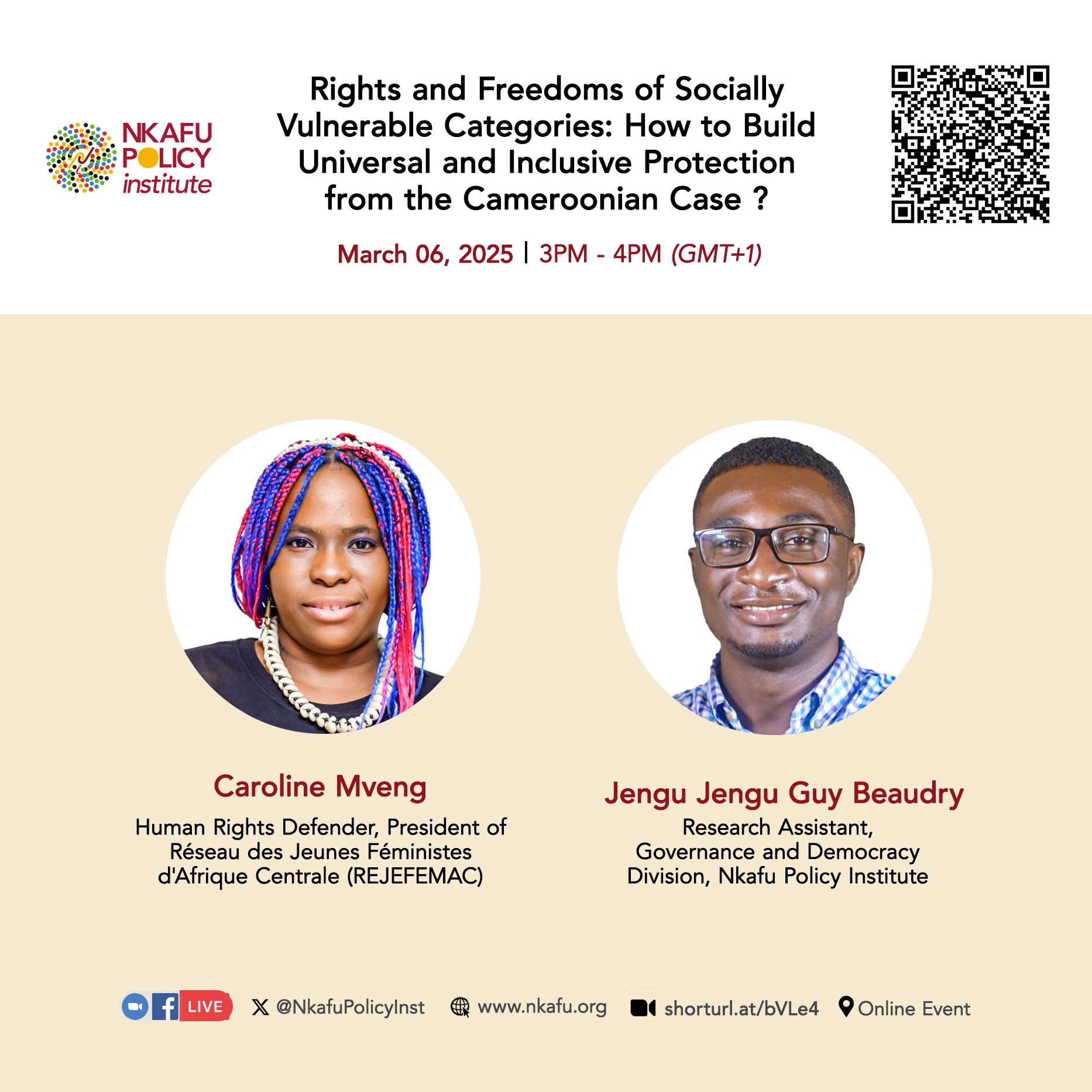
Date: March 6, 2025,
Time: from 3:00 p.m. to 4:00 p.m
Venue: Zoom Online (Register now)
- Background
While African states have for several decades made commitments at the international and national levels to guarantee the rights and freedoms of all individuals, certain social categories considered vulnerable continue to face systemic obstacles in the effective enjoyment of their rights. Women and people with disabilities are particularly concerned: data shows that they encounter specific obstacles in accessing their social, political and economic rights. (1). It is in this general context that the Nkafu Policy Institute has produced a report entitled “Rights and freedoms of socially vulnerable categories”, to analyze in the specific case of Cameroon, the state, challenges and prospects of the rights and freedoms of these two social categories. This conversation will then mainly focus on a discussion of the main results of this report, in order to understand, from the case of Cameroon, the situation of women and people with disabilities in Africa, particularly in a context of socio-political crisis and economic and cultural challenges.
- Objectives
The objective of this conversation is to broadly analyze the main ideas of the report based on evidence from Cameroon and other African countries, to highlight general trends and strategies to improve access to rights for women and persons with disabilities. Specifically, it will:
- Analyze and assess the effectiveness of current legal and social mechanisms that enable women and persons with disabilities to exercise their rights in all areas ;
- Identify gaps and systemic barriers (discrimination, exclusion, poverty, gender-based barriers, intersectionality) that hinder universal access to fundamental freedoms for women and persons with disabilities ;
- Promote inclusive public policies that integrate participatory approaches to ensure that the voices of vulnerable people shape decisions that affect them ;
- Facilitate wide dissemination of the report on the rights and freedoms of women and people with disabilities so that this document serves as a lever to influence public policies, raise awareness and enable those concerned to fully take ownership of their rights.
- Expected Outcomes
- Raise awareness about the rights of women and people with disabilities:Make it known that respect for the rights of women and people with disabilities is a community affair and the balance of societies is based on the inclusion and respect of all its members ;
- Encourage women and people with disabilities to claim their rights:get the targets of the report to break the silence on the different forms of abuse they are victims of ;
- Advocate for more inclusive policies and programs or those specifically dedicated to women and people with disabilities:Get public decision-makers to draw inspiration from the recommendations of the report and the conversation to strengthen discriminatory measures against women and people with disabilities.
- Expected Outputs
- Renewal of the approach in the analysis of human rights: adopt an analysis of rights and public policies that directly target women and people with disabilities, to avoid the generalist or holistic approaches regularly used, which do not allow for a specific assessment of the evolution of the rights of certain social groups that face specific challenges ;
- Promote the dissemination of the report: This conversation will help to better highlight the importance of such a report and facilitate its dissemination to participants in the form of a directly accessible link ;
- Publication of the conversation on On Policy Magazine:This conversation will be published in the form of a dialogue on the Nkafu Policy Institute magazine.
- Target audience
This Conversation is accessible to everyone, without restriction.
- Event Format
The Conversation will take place online, via the Zoom platform and will be simultaneously broadcast on the Denis & Lenora Foretia Foundation’s social media channels. In addition, French to English interpretation will be available throughout the conversation, to ensure that all participants understand the analyses.
- Event Date
This is a one-hour event, which will be held on March 6, 2025, from 3:00 p.m. to 4:00 p.m. Cameroon time.
- About the Denis & Lenora Foretia Foundation
The Denis & Lenora Foretia Foundation was established to catalyze Africa’s economic transformation by focusing on social entrepreneurship, science and technology innovation, public health, and progressive policies that create economic opportunities for all. The Foundation partners with local governments, policymakers, private enterprises, civil society organizations, and development partners to expand resources available to entrepreneurs, farmers, and small business owners, improving individual livelihoods.
9.About the Nkafu Policy Institute
The Nkafu Policy Institute is an African think tank with a mission to provide independent, in-depth, and insightful policy recommendations that enable all Africans to prosper in free, fair, democratic, and sustainable economies. The Institute’s team of analysts, experts, and researchers works on governance and democracy, health and education, peace and security, science and technology, and economic policy.
Contact
Questions related to the organization of this event can be sent to Ms Vanessa Aboudi, Policy Analyst, Nkafu Policy Institute [email protected].
Nkafu Policy Institute
P: (+237) 222 31 15 84 / (+237) 654 86 72 54/[email protected]
www.nkafu.org


 Denis & Lenora Foretia Foundation | Catalyzing Africa's Economic Transformation
Leave A Comment