

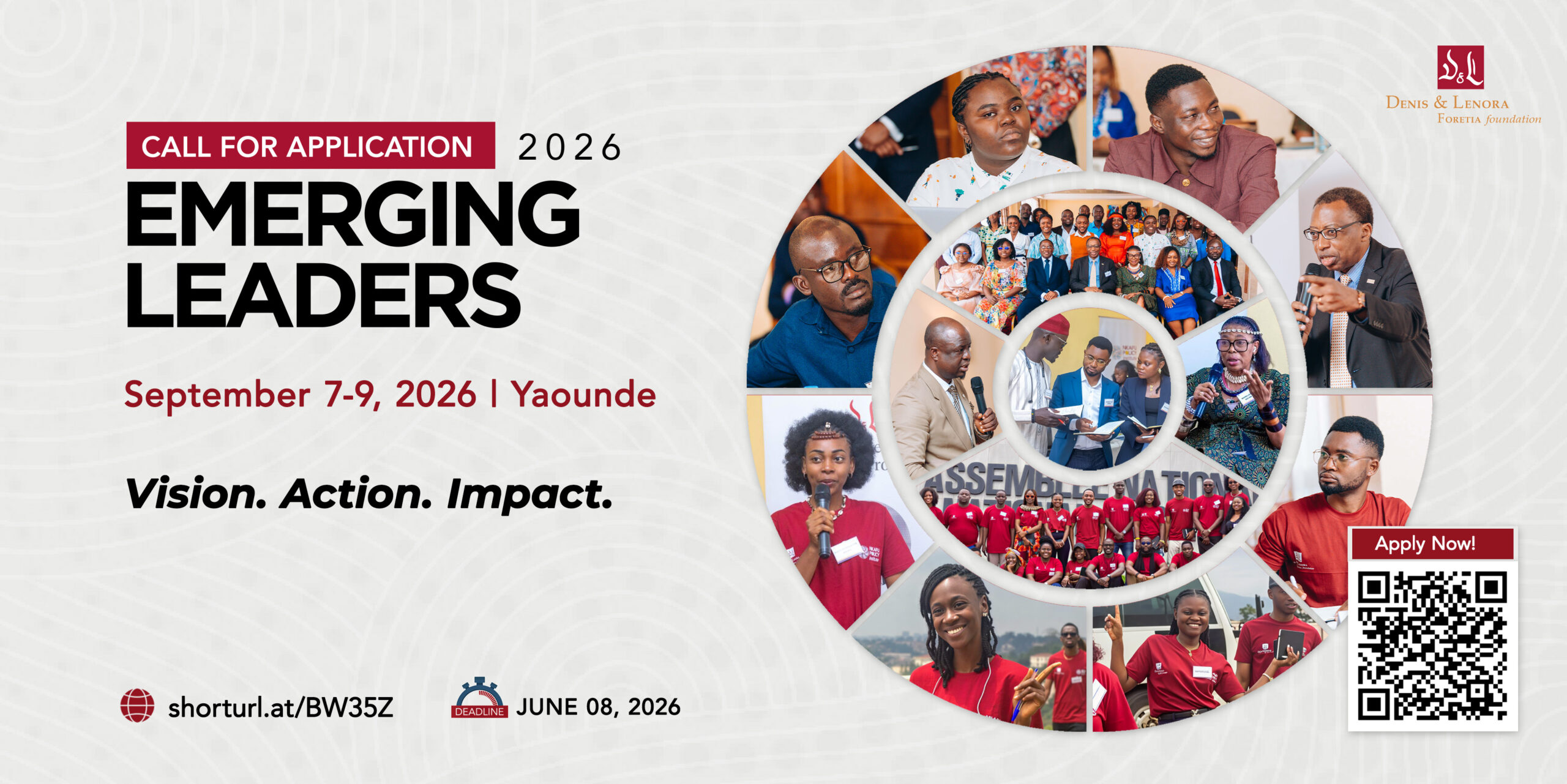
Date: 07-09, September 2026
Time: 8:00 AM to 5:00 PM daily.
Mode: In-person in Yaoundé, Cameroon
Register now
Context
Cameroon stands at a pivotal moment in its development trajectory, with young people constituting more than 69% of the population—an unprecedented demographic advantage that carries both promise and urgency (Britannica, 2026). Yet, despite their vast potential, many youths and women remain excluded from meaningful decision?making spaces and lack the leadership pathways needed to influence governance, social development, and economic transformation. Opportunities for structured leadership development, mentorship, and practical exposure remain limited, creating a persistent gap between vision and real, community?level impact.
This gap is not due to a lack of ambition or creativity. Across Cameroon, young leaders continually demonstrate their capacity to imagine innovative solutions to pressing social challenges. What remains missing is a system that supports them in refining their vision, translating ideas into action, and producing measurable impact. As leadership scholar Warren Bennis emphasizes, leadership is the capacity to translate vision into reality — a process that requires clarity, strategy, discipline, and the right enabling environment. Research such as the 2024 study on youth empowerment in Buea Municipality confirms that while national youth policies exist, they remain inadequate in addressing young people’s leadership needs, highlighting challenges such as insufficient training, lack of resources, and weak institutional support systems. [researchgate.net]
In response to these gaps, the Nkafu Policy Institute is launching the 5th edition of the Emerging Leaders Program under the theme “Vision. Action. Impact.” This theme reflects the full arc of leadership development that young Cameroonians need today.
- Vision: cultivating clarity of purpose and alignment with national development priorities.
- Action: equipping emerging leaders with the practical tools, strategic thinking skills, and ethical grounding required to implement their ideas.
- Impact: enabling leaders to design community?focused initiatives and to generate tangible, sustainable results.
Through a blended approach of theoretical grounding, experiential learning, mentorship, and long?term follow?up, the 2026 edition moves beyond a training event — it becomes a leadership journey. By supporting participants from the moment they articulate their vision to the moment they implement real projects in their communities, the program builds a new generation of leaders capable of shaping a more inclusive, innovative, and prosperous Cameroon.
Objectives
The program seeks to empower Cameroonian women and youth with essential leadership skills through focused training and mentorship. Specifically, it aims to:
- Equip participants with tools and frameworks for developing clear and compelling visions, aligned with national development priorities
- Equip participants with skills necessary to translate innovative ideas into impactful actions
- Instill in participants a strong sense of ethical leadership, integrity, empathy, respect and a commitment to building an inclusive and united Cameroonian society
- Create a network of proactive young citizens that fosters collaboration, knowledge exchange, and sustained support
Expected Outputs
The program will generate the following immediate and short?term outputs:
- Twenty (20) Young Cameroonians Trained in Leadership and Policy Skills: A cohort of 20 participants, selected from all 10 regions, will complete the 3?day intensive leadership development training.
- Vision Statements Developed by All Participants: Each participant will produce a personal and professional vision statement, assessed for clarity, strategic orientation, and alignment with community or national priorities.
- Training Resources Developed and Distributed: Relevant training material on the various sessions will be distributed to participants for continued learning and application.
- Pre? and Post?Training Assessment Results: A complete dataset of participants’ pre- and post-training results will be compiled to measure knowledge gains in leadership, ethics and policy processes.
- Peer Networks and Cross?Regional Collaborations Established: A functional cross-regional peer network will be created, enabling ongoing collaboration among participants beyond the training period.
- Comprehensive Program Report Produced: A detailed program report will be compiled, including: participant profiles, training outcomes, assessment results, evaluation data, recommendations for future editions
- Follow?Up Engagement Plans Developed: Periodic follow up will be done on the implementation of lessons learnt by Emerging Leaders throughout the program.
- Post-training mentoring program developed: Mentor and mentee relationships created to foster, skill development and professional growth of Emerging Leaders.
- Documentation of Participant Outputs for Policy and Communication: Emerging Leaders will be affiliated to the Denis & Lenora Foretia foundation for a period of 1 year, and will be expected to produce at least a policy brief/op-ed/short article on a topic of their choice, to be published by the Foundation.
Expected Outcomes
By the end of the program, participants will have:
a. Demonstrated Capacity for Visionary and Strategic Leadership
Participants will produce written personal and professional vision statements that meet specific criteria for clarity, feasibility, and alignment with community or national priorities. At least 80% of participants will show measurable improvement between pre? and post?training assessments on leadership concepts, including strategic planning and ethical decision?making
b. Improved Ethical Leadership Competencies
Participants will exhibit enhanced ethical reasoning, integrity, and teamwork. This will be measured through facilitator observation scores, peer assessments, and a minimum 20% improvement in post?training ethical leadership knowledge tests.
c. Strengthened Understanding of Governance, Public Policy, and Civic Engagement
Participants will achieve at least a 25% improvement in governance and policy knowledge scores from pre? to post?training assessments and produce one policy-oriented output (article, op?ed, or policy brief) during the follow?up period. Performance will be evaluated based on clarity, evidence use, and policy relevance.
d. Increased Collaboration and Networking Across Regions
Participants will expand their professional networks by collaborating with peers from at least three different regions of Cameroon during program tasks. Networking will be measured through network mapping surveys and participation in the June 2027 alumni event.
Target Audience
The program is open to:
- Women and youth from diverse backgrounds active in community initiatives, public service, entrepreneurship, or civil society.
- Individuals demonstrating a commitment to leadership, innovation, and social impact.
- Participants will be selected from all the 10 regions of Cameroon. Regional and gender representation balance will be ensured.
- Females and youths from under-represented communities are strongly encouraged to apply.
Participation Requirements
Applicants must meet the following criteria:
- Cameroonians aged 18–35 and residing in Cameroon
- Proficient in English and French
- Demonstrated interest in leadership, governance, research and/or community development
- Strong motivation and alignment with program objectives.
- Commitment to participating fully in the three-day program
- Commitment to engage in post-training activities
- Participants must possess a good and functional laptop during the program
Selection Timeline
- Call for Applications: March 16th, 2026.
- Application Deadline: June 8th, 2026.
- Application Screening: June 11th – 30th, 2026.
- Interviews and Selection of Successful Applicants: July 6th – 10th, 2026.
- Final Selection Announcement: July 13th, 2026.
- Emerging Leaders Program in Yaoundé: September 7th – 9th, 2026.
Program Format and Date
- The program will constitute a blend of theory and practice to ensure that participants not only learn concepts, but also develop the capacity to implement them effectively. This combination ensures that participants are empowered to address real-world challenges with confidence and competence.
- Theoretical sessions will focus on leadership principles, policy formulation, and global ethical standards.
- Practical methods will include hands-on workshops, mentorship and peer networking
Date: 07-09, September 2026
Time: 8:00 AM to 5:00 PM daily.
Mode: In-person in Yaoundé, Cameroon
Selection Process: Participants will be selected via a call for applications. All costs associated to this program will be fully covered by the Denis & Lenora Foretia foundation including; transportation, accommodation, meals and workshop materials for selected participants.
Program Content
The three-day program offers an intensive and interactive curriculum designed to develop well-rounded leaders. The modules include:
Day 1: Leadership Foundations
- Self-Awareness and Visioning: Understanding personal values and goals.
- Strategic Planning: Techniques for effective decision-making and goal-setting.
- Ethical Leadership: Principles of integrity and moral responsibility.
Day 2: Understanding Cameroon’s governance structure
- Story-telling: Leadership in the Cameroonian context
- Policy influencing: Engaging Policymakers through research and advocacy
- Sustainable Development: Aligning initiatives with global and local needs.
- Resilience and Well-being: Strategies for maintaining balance and overcoming challenges
Day 3: Communicating for Impact
- Developing personal brands: Leveraging social media for strategic communication
- Building Partnerships: Leveraging networks for collective action.
- Cultural Competence: Navigating diverse contexts with empathy and understanding.
Evaluation and Follow-Up
To assess participants’ progress and program effectiveness, the following evaluation methods will be applied:
- Pre-Training Assessment:
-
- Method: Online survey measuring baseline knowledge of leadership concepts, policy formulation, and governance principles.
- Focus Areas: Self-awareness, understanding of leadership, and familiarity with leadership strategies.
- Active Participation Evaluation:
-
- Method: Observation and scoring of participant involvement during sessions, group discussions, and debates.
- Criteria: Active engagement, critical thinking, teamwork, and communication skills.
- Post-Training Knowledge Test:
-
- Method: A structured questionnaire designed to assess knowledge improvement and practical understanding gained during the program.
- Feedback Surveys:
-
- Method: Anonymous surveys to gauge participants’ satisfaction with program content, facilitation, and logistics.
- Purpose: Inform future cohorts of the Emerging Leaders Program.
Follow-Up Engagement
Post-training engagement ensures that participants continue applying their knowledge and skills while contributing to broader societal goals.
Engagement Methods and Activities:
- Quarterly Check-Ins:
- Participants will have group sessions with assigned mentors to discuss progress and challenges.
- Duration: Quarterly, from October 2026 to June 2027.
- Alumni Networking Event:
- Networking webinar or in-person meetup to share experiences, challenges, and lessons learned.
- Duration: event to take place in June 2027.
Timeline for Follow-Up
| Activity | Timeline | Frequency |
| Quaterly Mentorship Check-Ins | October 2026 –June 2027 | Quarterly (October, January, April, June sessions) |
| Policy Contributions | November 2026 –May 2027 | 1 co-authored article or policy brief per emerging leader |
| Alumni Networking Event | June 2027 | Annually |
Facilitators and Organizers
The program will be hosted by the Nkafu Policy Institute of the Denis & Lenora Foretia Foundation and facilitated by experts from both public and private sectors, bringing diverse perspectives to enrich participants’ learning experiences.
About the Denis & Lenora Foretia Foundation
The Denis & Lenora Foretia Foundation was established to catalyze Africa’s economic transformation by focusing on social entrepreneurship, science and technology innovation, public health, and progressive policies that create economic opportunities for all. The Foundation partners with local governments, policymakers, private enterprises, civil society organizations, and development partners to expand resources available to entrepreneurs, farmers, and small business owners, improving individual livelihoods.
About the Nkafu Policy Institute
The Nkafu Policy Institute is an African think tank with a mission to provide independent, in-depth, and insightful policy recommendations that enable all Africans to prosper in free, fair, democratic, and sustainable economies. The Institute’s team of analysts, experts, and researchers works on governance and democracy, health and education, peace and security, science and technology, and economic policy.
Contacts
Questions related to the organization of this event can be sent to:
Ms. Muriel Kinkoh, Research Associate, Nkafu Policy Institute – [email protected]
Ms. Endurance Vunan, Assistant Operations Manager, Denis & Lenora Foretia Foundation – [email protected]



 Denis & Lenora Foretia Foundation | Catalyzing Africa's Economic Transformation
Leave A Comment