Written By: Dr Jean Cedric Kouam, Dr Bin Meh, Laurent Brice Nsengue, Isidore Njinju Asongalem, Meh Desmond Kum
Introduction
In defining its new National Development Strategy 2020-2030 (NDS30), the Cameroonian government set its ambition of achieving double-digit economic growth by 2030. To achieve this, one of the main strategies put in place is to go after markets with high development potential. Among the major markets to be explored, ‘the Nigerian market occupies a prominent place’. This market indeed has several assets in terms of SMEs in the field of industrial production. According to the government, the development of trade with Nigeria has the particularity that it will cover a whole range of products, from primary products (oil), food, and industrial products, to services (energy supply). However, it remains necessary to strengthen the competitiveness of national companies to ensure that companies operating in these high-potential markets do not crush them.
The Cameroonian government has been working since 2021 to implement the import-substitution policy, which entails replacing the nation’s imports with locally produced goods and services, in addition to capturing high-potential markets (Sawyer and Sprinkle, 2009). Unfortunately, these objectives will be impossible to achieve if the business environment remains gloomy.
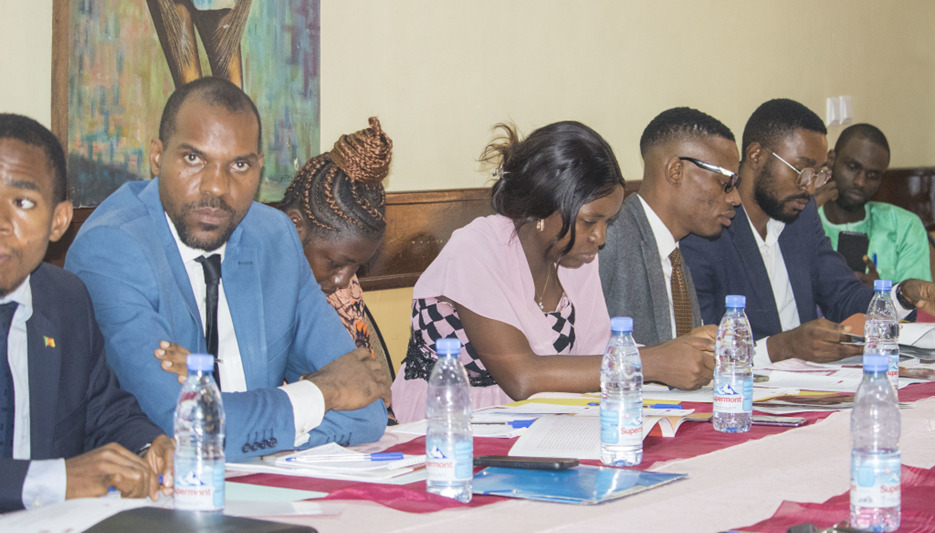
To provide practical responses to improve the business climate in Cameroon, the Small Business and Entrepreneurship Center (SBEC) at the Denis and Lenora Foretia Foundation organized a working session in Yaoundé on March 17, 2023, with several actors of the Cameroonian entrepreneurial ecosystem. Following its mission to support SMEs across the country and promote business-friendly policies that stimulate innovation and job creation, this meeting aimed to determine how to improve the business environment to strengthen the resilience of SMEs in Cameroon.
We will outline the key proposals made by the various players in the Cameroonian entrepreneurial ecosystem in this policy brief in order to achieve the desired outcomes. First, it is worth recalling the main policy options chosen by the government to improve the business climate in Cameroon. The stake is to convince the authorities of the urgent need to improve the business climate in Cameroon.

Jean Cedric Kouam is the Deputy Director-Economics Affairs Division and the Head of Fiscal and Monetary Policy Sub-section at the Nkafu policy Institute. He holds a doctorate in economic policy and analysis (monetary and financial macroeconomics) from the University of Dschang in Cameroon.

Bin Joachem Meh is a Research Assistant in the Department of Economics Affair at the Nkafu Policy Institute. He is a Ph.D. Fellow in Labour and Development Economics in the University of Bamenda. He is multidisciplinary, as he holds a B.Sc. and M.Sc. in Economics and Financial Engineering from the University of Yaounde II Soa and M.Sc. in Banking and Finance from the University Rennes 1 France.

Laurent Brice Nsengue
Mr. Nsengue Laurent Brice is an Assistant SBEC Manager at the Denis & Lenora Foretia Foundation. He holds a Master's degree in International Relations with a major in Regional Integration and Management of Community Institutions from the Institute of International Relations of Cameroon (IRIC), a Master's degree in Economics with a major in Public Policies and Sustainable Development and a Bachelor's degree in Economics with a major in Money, Banking and Finance.

Isidore Njinju Asongalem




 Denis & Lenora Foretia Foundation | Catalyzing Africa's Economic Transformation