
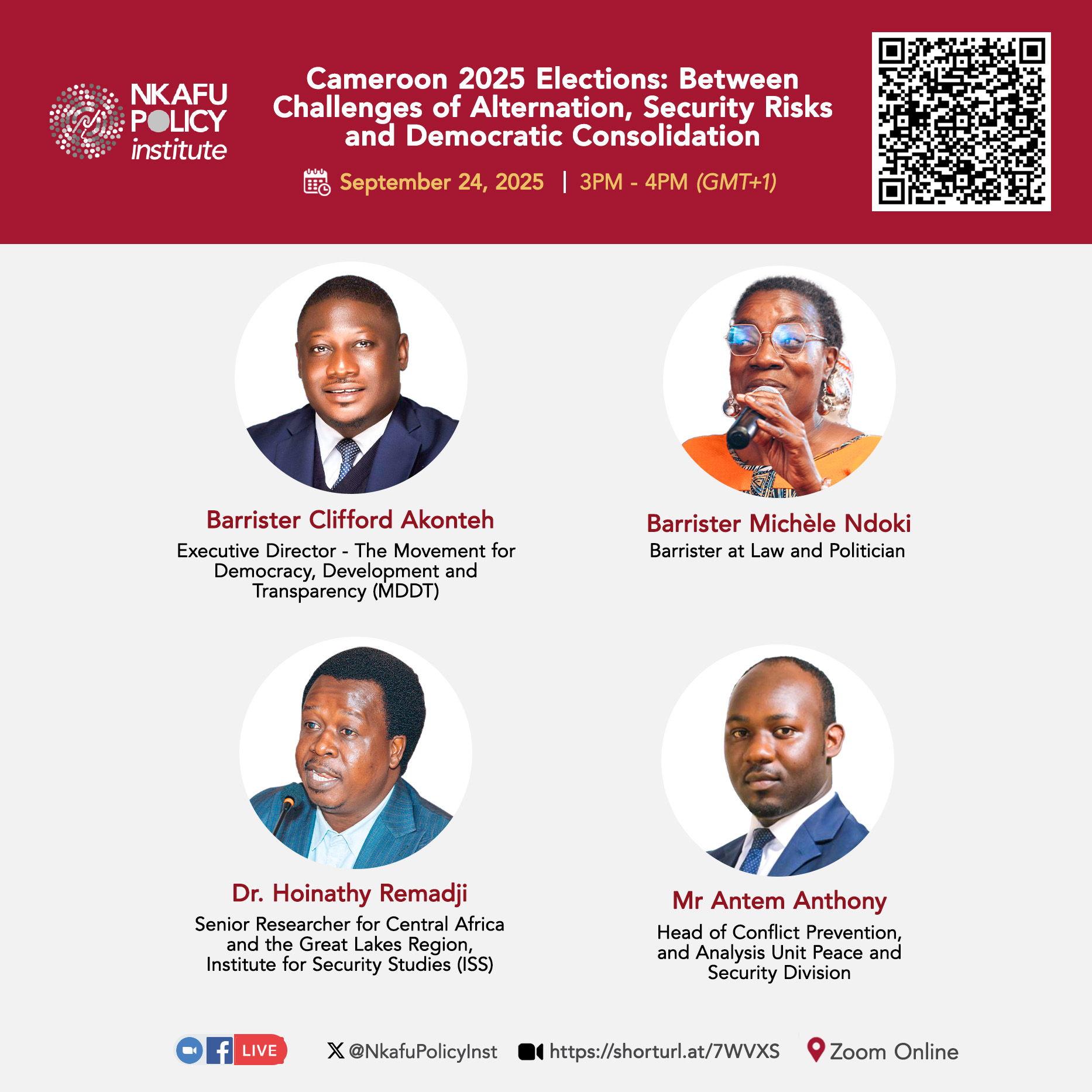
Date: September 24th 2025
Time: 3:00pm – 4:00pm (WAT)
Venue: Zoom Online
Context
The 2025 presidential elections in Cameroon is taking place in a national context marked by rising political, social, and security tensions. On the political front, President Paul Biya, aged 92, is seeking an eighth term after more than forty years in power (1).This longevity raises significant questions about the management of political transition. The composition of the Constitutional Council as well as the institutional links between Elections Cameroon (ELECAM), the territorial administration, and the ruling CPDM party raise questions about the independence of electoral processes and the fairness of political competition (2). Moreover, the main opposition leader Maurice Kamto saw his candidacy rejected by ELECAM, a rejection confirmed on August 5 by the Constitutional Council which dismissed his appeal(3). In the same vein, two former Ministers of State have resigned from their positions to file their candidacies, a turning point that further disrupts the scenario of a presidential election that seemed predetermined (4). However, these new candidacies do not resolve the divergences within the opposition regarding the formation of a united coalition, thus compromising the prospects for political transition. On the security front, Cameroon is particularly weakened by two major crises. In the North-West and South-West regions, a prolonged conflict pits government forces against Anglophone separatist groups, who threaten to violently disrupt the conduct of elections by instituting boycotts and blockades (5), thus compromising electoral participation in these areas. Furthermore, the Far North region is confronted with a resurgence of Boko Haram attacks, considerably aggravating insecurity and disrupting civilian life, including the organization of polls. These conflicts have caused massive population displacements, complicating electoral logistics and accentuating the exclusion of certain citizens from the democratic process. Faced with these challenges, holding free, fair, and peaceful elections appears as a major stake for the country’s stability.
Objectives
This webinar aims to analyze and debate the main issues related to the 2025 presidential election in Cameroon, focusing on the challenges of political alternation, security risks, and mechanisms for democratic consolidation. More specifically, it seeks to:
- Assess the political and social conditions ahead of the 2025 elections and identify obstacles to a peaceful and credible political alternation.
- Evaluate security threats likely to affect the electoral process, as well as strategies to ensure a secure and inclusive election.
- Promote best practices and recommendations to strengthen democracy through transparent electoral institutions, peaceful political dialogue, and active citizen participation.
Expected Outcomes
At the end of this process, the goal is to achieve:
- A better understanding of the political issues specific to the October 12, 2025 presidential election, particularly in terms of governance and alternation; Increased awareness of the effects of security risks on holding reliable and transparent elections;
- Concrete recommendations to strengthen electoral institutions, encourage citizen inclusion, and ease political tensions;
- The promotion of an inclusive national dialogue aimed at fostering a peaceful and stable political climate.
Target Audience
This reflective effort is primarily addressed to:
- political decision-makers and institutions in charge of organizing elections; political parties,
- civil society and human rights organizations; national and international actors involved in peace and security;
- mediaorgans that focus on political communication
- researchers who specializein political science and democratic development; and
- the entire Cameroonian citizenry.
Event Format
The webinar will take place online, via zoom through an interactive panel discussion by experts and will be streamed live across all organizational media outlets.
Event Date
The one-hour long event is scheduled to hold on September 24th 2025 from 3:00pm to 4:00pm.
About the Denis & Lenora Foretia Foundation
The Denis & Lenora Foretia Foundation was established to catalyze Africa’s economic transformation by focusing on social entrepreneurship, science and technology innovation, public health, and progressive policies that create economic opportunities for all. The Foundation partners with local governments, policymakers, private enterprises, civil society organizations, and development partners to expand resources available to entrepreneurs, farmers, and small business owners, improving individual livelihoods.
About the Nkafu Policy Institute
The Nkafu Policy Institute is an African think tank with a mission to provide independent, in-depth, and insightful policy recommendations that enable all Africans to prosper in free, fair, democratic, and sustainable economies. The Institute’s team of analysts, experts, and researchers work on governance and democracy, health and education, peace and security, science and technology, and economic policy.
Contact
Questions related to the organization of this event can be sent to:
Mr. Antem Anthony, Policy Analyst, and Head of Conflict Prevention and Analysis Unit, Peace and Security Division, [email protected]
OR
Ms. Aboudi Vanessa, Policy Analyst, Governance and Democracy Division, [email protected]
Nkafu Policy Institute, P: (+237) 222 31 15 84 / (+237) 654 86 72 54, www.nkafu.org.


 Denis & Lenora Foretia Foundation | Catalyzing Africa's Economic Transformation
Leave A Comment