
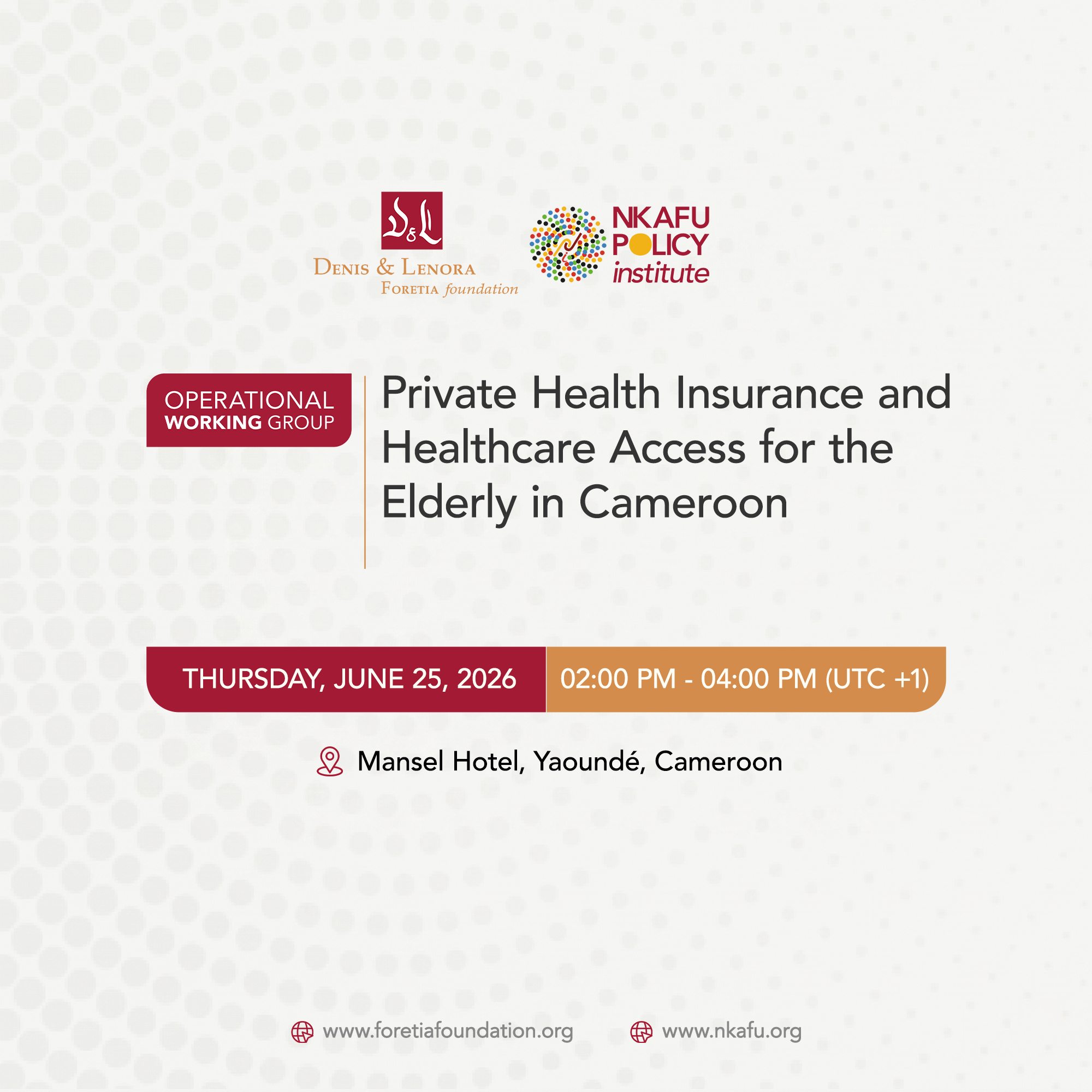
Date: June 25, 2026
Time: 02:00pm – 04:00pm
Venue: COFE Hotel, Yaoundé
Background
Cameroon’s population is gradually ageing, with an estimated 840,000 people aged 65 years and above in 2025, a figure projected to rise steadily in the coming decades. Ageing is accompanied by increased vulnerability to illness, reduced income, and growing healthcare needs, all of which threaten the wellbeing and dignity of older adults. Non-communicable diseases (NCDs) such as hypertension, diabetes, stroke, arthritis, cancer, kidney disease, and depression are highly prevalent among the elderly, and many older people experience multimorbidity, require frequent medical consultations, diagnostic tests, and long-term medication. Yet healthcare financing in Cameroon remains dominated by out-of-pocket payments, while social protection mechanisms for older adults are weak or absent. Pension coverage reaches only a small proportion of the elderly population, and benefits are often insufficient to meet rising healthcare costs.
Although private health insurance (PHI) is expanding in Cameroon, current schemes are poorly adapted to the risk profile and care needs of older adults. Age-related exclusions, high premiums, and limited coverage of chronic conditions effectively exclude most elderly people from meaningful insurance protection. Existing public initiatives, including the first phase of Universal Health Coverage (UHC), prioritize maternal and child health and selected chronic conditions, leaving significant gaps in long-term care for older people.
In this context, inclusive and age-sensitive private health insurance models could play an important complementary role in improving access to healthcare and reducing catastrophic health expenditures among the elderly. The policy paper “Access to Private Health Insurance for the Elderly in Cameroon” highlights key barriers and policy options for improving coverage. This Operational Working Group (OWG) aims at building on these findings to identify practical, equitable, and sustainable strategies for enhancing PHI coverage for older adults in Cameroon.
Objectives
- To critically review the policy paper and discuss the main financial, regulatory, and structural barriers limiting access to private health insurance for the elderly.
- To explore age-sensitive and inclusive PHI models suitable for Cameroon’s demographic and socioeconomic context.
- To develop actionable policy and regulatory recommendations to improve health insurance coverage and healthcare access for the elderly.
Expected Outputs
The expected outputs are:
- New insights on the key healthcare and financial protection challenges faced by elderly populations in Cameroon.
- Identified gaps in existing private health insurance schemes affecting older adults.
- Practical, evidence-informed recommendations for designing and regulating age-sensitive PHI products.
- Strategic inputs to inform the roadmap for expanding private health insurance in Cameroon.
Target Participants
This OWG will gather government representatives from the Ministry of Public Health, Social affairs and Finance; private health insurance providers and actuarial experts; Pension and social security institutions (CNPS); Geriatric care specialists and healthcare providers; health economists and health systems researchers; civil society organizations and patient advocacy groups representing older people; development partners and technical agencies working on ageing, NCDs and social protection.
Venue & Date
This OWG will take place on June 25, 2026, at COFE hotel (Yaoundé) from 02:00pm – 04:00am.
About the Organizers
- About the Denis And Lenora Foretia Foundation
The Denis & Lenora Foretia Foundation was established to accelerate Africa’s economic transformation by focusing on social entrepreneurship, science and technology, innovation, public health and progressive policies that create economic opportunities for all. The foundation works in partnership with local governments, policy makers, private enterprises, civil society organizations as well as development partners to expand the resources available to entrepreneurs, farmers, and small business owners in addition to improving individual livelihoods.
- About the Nkafu Policy Institute
The Nkafu Policy Institute is an African think tank with a mission to provide independent, in-depth and insightful policy recommendations that allows all Africans to prosper in free, fair, democratic and sustainable economies. The Institute is made up of analysts, experts and researchers from all over the world, working on a wide range of topics, including governance and democracy, health and education, peace and security, science and technology, and economic policy.


 Denis & Lenora Foretia Foundation | Catalyzing Africa's Economic Transformation
Leave A Comment