Skip to content
Denis & Lenora Foretia Foundation | Catalyzing Africa's Economic Transformation Logo Denis & Lenora Foretia Foundation | Catalyzing Africa's Economic Transformation Logo Denis & Lenora Foretia Foundation | Catalyzing Africa's Economic Transformation Logo
  • Home
  • About Us
    • Letter from Co-Chairs
    • Leadership
    • Values
    • Code of Conduct
    • FAQs
  • Programs
    • Nkafu Policy Institute
      • Branding
    • 2026 Executive and Strategic Leadership Program
    • Workshop on Scientific and Manuscript Writing
    • Small Business & Entrepreneurship Center
    • Emerging Leaders
    • ON POLICY Magazine
    • Others
      • The STEM Prize
      • Sustainable Development Program
      • Health Initiative
        • BornFyne Project
        • Health Research Grants
        • Health Policies Publications
        • Covid-19 In Cameroon
  • News
    • Publications
    • News
    • Projects
  • Events
  • Get Involved
    • Careers
    • Internship Program
    • Contact Us
  • Forums
    • 2026 Central Africa Thinktank Forum
    • Africa @ World Bank/IMF Spring Meetings
    • 2025 SBEC Forum
  • Donate

Posts

  1. Home
4 events found.

Events

Events Search and Views Navigation

Event Views Navigation

  • List
  • Month
  • Day
  • Photo
  • Summary
Today

List of events in Photo View

  • COVID-19 and the Future of Work – A Global Perspective
    Jun 16

    COVID-19 and the Future of Work – A Global Perspective

    3:00 PM - 4:30 PM
    Free
  • COVID-19 & Africa’s Health Sector – A Conversation with Dr John Nkengasong
    Jun 29

    COVID-19 & Africa’s Health Sector – A Conversation with Dr John Nkengasong

    11:00 AM - 12:00 PM
    Free
  • Assessing Cameroon’s Response To The Covid 19 Pandemic ASSESSING CAMEROON’S RESPONSE TO THE COVID 19 PANDEMIC-lin
    Jul 30

    Assessing Cameroon’s Response To The Covid 19 Pandemic

    2:00 PM - 4:00 PM
    Free
  • COVID-19 and African Economies: A Conversation with Charles Boamah
    Aug 14

    COVID-19 and African Economies: A Conversation with Charles Boamah

    3:00 PM - 4:00 PM
    Free

  • Today
  • Next Events
  • Google Calendar
  • iCalendar
  • Outlook 365
  • Outlook Live
  • Export .ics file
  • Export Outlook .ics file

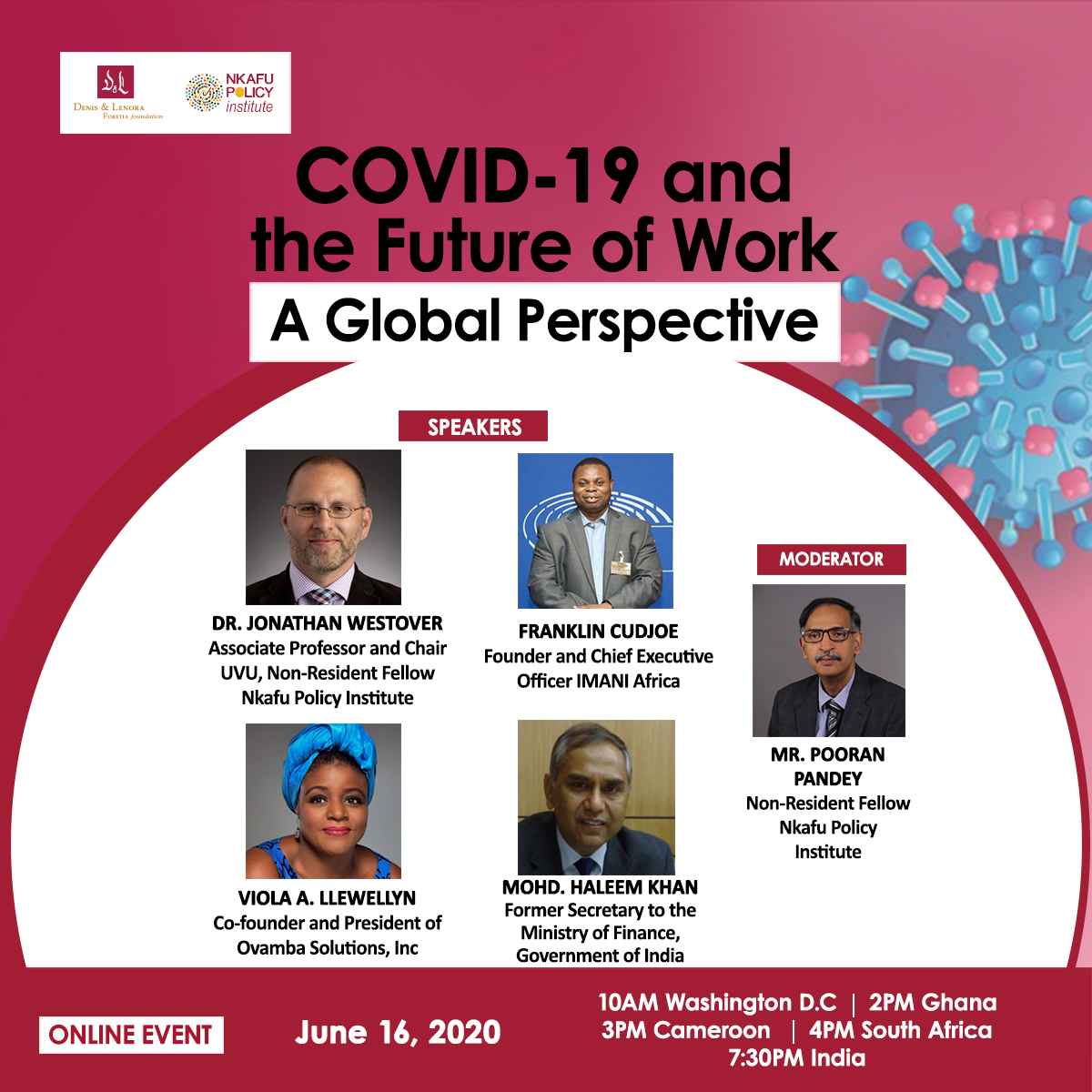
June 16, 2020 at 10AM Washington D.C
(2PM Ghana, 3PM Cameroon, 4PM South Africa, 7:30PM India)

 BACKGROUND

Approximately half of the world’s population is under varying levels of restricted movement in an attempt to stop the spread of COVID-19, a public health emergency that has claimed thousands of lives and sparked fears of the worst global recession since the Great Depression. This sudden decrease in movement has had a profound impact on the way we work, our mental, and physical well-being. As a result, many social scientists and psychologists around the world are keenly observing the implications of this enforced global experiment on work behaviors, hours, and locations, to name a few. While these restrictions have forced employees in many organizations to work from their homes, thereby managing their tasks and time with little supervision, it has also caused a steep rise in unemployment rates in sectors such as hospitality and entertainment that require workers to physically deliver the services.

Home-based work has not been without challenges. Some workers report similar or improved performance at home, compared to working in an office, while others report reduced performance from struggling to balance work and other commitments such as dependent care. Companies, on the other hand, are recording financial gains from reduced travel, utility, sometimes rent expenses in the short run, but the long-term trade-off in potential productivity, culture, and profitability decline are unknown. Though we cannot predict the future, one thing is sure, the pandemic and the emergency measures that were taken by most organizations will completely change the perception and nature of work in the future. These changes may include redesigning job performance expectations, travel requirements, and working hours to reconcile newly developed work habits with post-pandemic norms. According to Adam Grant, a professor of Management and Psychology at the University of Pennsylvania’s Wharton School, leaders could take the opportunity to give their employees more control and, hopefully, discover that they can trust them to manage their schedules. Leaders may want to become more hands-on in learning about their employees’ values, interests, strengths, and motivations.

After the pandemic, many organizations will continue to experiment with different ways of working, including shorter workdays or may embrace long-term work from home for most or all employees. The pandemic has hastened the evolution of work to a more virtual workforce than the world was prepared for. As the world scrambles to adapt to the current work situation, what should governments, policymakers, organizations, and workers expect in the post pandemic world?

Purpose of the event

  • Identify the changes and challenges to how workers participate in the workforce
  • Identify the effects of the changes in work on organizations, governments, policymakers, and workers.
  • Forecast the post-pandemic work environment and propose recommendations on how various employers and employees can quickly adapt and reconcile past working habits with new developments and experiences from the pandemic.

Who will attend?

  • This event will bring together participants from various fields of expertise, including head of organizations, government and policymakers, workers in different areas, managers, entrepreneurs, labor officials, researchers, students, and the general public.

 Date

June 16, 2020 at 10AM Washington D.C (2PM Ghana, 3PM Cameroon, 4PM South Africa, 7:30PM India)

Areas of concern

There will be presentations on key facts about the current pandemic, and the changes that are occurring with structured work. The major areas of concern will be economic and technological development, labour law, public policies, psychology, and social welfare and any other areas not mentioned but the panelists think could greatly contribute to the discussion.

Expected results

At the end of this event,

  • Changes brought about in work as a result of the current pandemic will be outlined.
  • All the effects of the pandemic on organisations, government, policy makers and workers will be identified.
  • There will be a forecast on the post pandemic work environment and concrete recommendations will be given for organisations, government and policy makers, workers and other participants as concerns the future of work.

SPEAKERS

Dr. Jonathan Westover

Associate Professor and Chair – UVU, Non-Resident Fellow – Nkafu Policy Institute

Franklin Cudjoe

Founder and Chief Executive Officer – IMANI Africa

Viola A. Llewellyn

Co-founder and President of Ovamba Solutions, Inc.

Mohd. Haleem Khan (IAS, Rtd.)

Former Secretary
Ministry of Finance, Government of India

Moderator

Mr. Pooran Pandey

Non-Resident Fellow – Nkafu Policy Institute

Online Platform
This event will be organized on ZOOM. There will be a Q&A session for participant engagement

Toggle Sliding Bar Area
Page load link
Denis & Lenora Foretia Foundation | Catalyzing Africa's Economic Transformation Denis & Lenora Foretia Foundation | Catalyzing Africa's Economic Transformation
Welcome back
Sign In
Sign in to access your downloads, manage your account, and continue where you left off.
Login Account
Enter your credentials to access your account
Forgot Password?
Don't have an account? Register Now
Go to Top